
Published April 23, 2026
April 2026 Market Snapshot (March Data)


Boulder Metro + Central Denver Metro
Spring is doing what spring usually does: more movement, more urgency, more “should we just do this now?” energy.
But here’s the part most headlines skip: this is a spring surge with cautious optimism—and it’s setting up a more active summer than last year.
Yes, activity is up. Yes, prices are up. And yes, in parts of Central Denver, homes are moving fast again.
But the biggest vibe-check is coming from two things: new listings that are priced/presented correctly are getting rewarded, and fewer new homes are hitting the market than this time last year across both markets.
And, as usual, the two markets are behaving somewhat differently. That’s where people make financially and emotionally expensive mistakes—when they apply the wrong strategy to a given micro-market or even an individual listing. There’s still no “one-size-fits-all” playbook.
The Quick Scoreboard
What’s Happening (In Plain English)
Here’s a cleaned-up, tighter, more “article” version of your section (same points, less repetition, smoother logic, and a couple of phrasing fixes):
First: demand is showing up — and it’s not slowing down yet (which is the opposite of what we saw starting in April of last year).
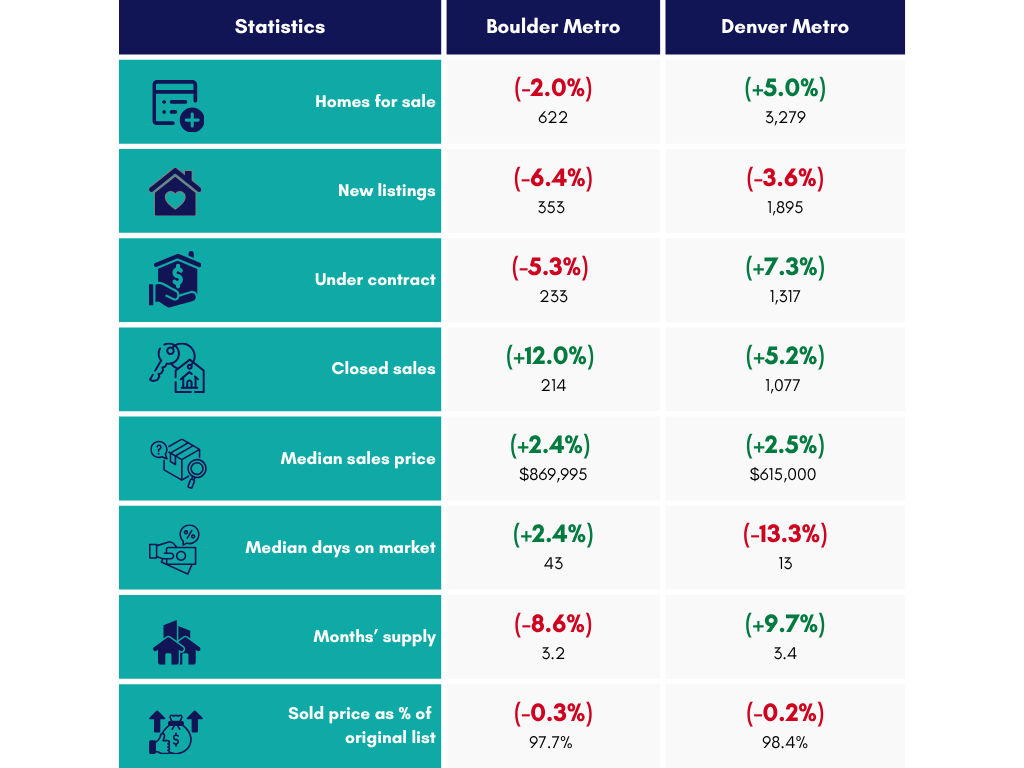
Closed sales are up in both markets: Boulder +12% and Central Denver +5.2%. That’s not just “more showings.” That’s more people actually pulling the trigger. Read: more demand.
Second: new supply is tighter than it looks.
With fewer new listings hitting the market than this time last year across both markets, there’s a lower volume of fresh inventory — the exciting, well-positioned listings that stand out from homes that have been sitting for a couple months. And when fresh supply tightens while demand rises, the median price tells the story: Boulder is up +2.4% and Central Denver is up +2.5% year-over-year.
Central Denver is also showing better momentum right now. More homes are going under contract (+7.3%) and they’re doing it much more quickly (13 days median). That combo is the tell: the good listings are getting snapped up fast.
Third: overall supply is mixed, which is why the vibe feels different depending on where you live.
Boulder has slightly fewer homes for sale year-over-year (-2%) and lower months’ supply (3.2 months, -8.6%). Central Denver has more homes for sale (+5%) and higher months’ supply (3.4 months, +9.7%).
So yes — spring surge.
But the caution inside the optimism is that the market is still selective. Sold price as a percent of original list price is slightly softer in both markets (Boulder 97.7%, Central Denver 98.4%). That’s not doom. It’s the split-market reality: great new listings can still get bid up, while homes that linger are still being aggressively negotiated by price-sensitive (or opportunistic) buyers. And just like every spring, those sold-to-list percentages tend to firm up as the season progresses.
Pro tip: Even as the market heats up, your first 7–10 days are everything. The listings that are new + priced right + presented well are rewarded with strong offers, and often bidding wars. The ones that miss the mark don’t “warm up” — they age, and then you’re negotiating from a weaker position.
What Sellers Need to Know Right Now
If you’re selling, this is the season where people get tempted into the most common spring mistake:
“80% is enough.”
When the market feels strong, sellers start believing they can get away with less time, less money, or less effort. They list with a discount broker because “everything is selling.” They skip staging a vacant home before photos and showings. They assume the market will do the heavy lifting.
Nothing could be farther from the truth.
The only listings generating multiple offers and real buyer competition are the ones that ace the prep, the photography, and the storytelling—the full package that makes the home feel like the obvious choice.
Here’s the cleaner way to think about it.
There is no “testing.” Your job is to create urgency with a price that makes sense relative to the competition, the value buyers actually see, and their alternatives the day you hit the market. If you list it for a dollar more than buyers think it’s worth—given what else they can buy—you won’t get offers. Then you’re chasing the market down.
And this isn’t just about the number on the listing. It’s also about the value you convey in the marketing and the way buyers experience the home in person.
In Central Denver, the speed is the tell. When the median days on market is 13, the market is basically saying: “If it’s priced and presented correctly, we’ll buy it.” That’s great news—if you do your job up front.
In Boulder, the median days on market is 43, and it’s slightly higher year-over-year—but don’t over-compare Boulder DOM to Denver DOM. Those numbers are tracked differently.
In Denver, it’s customary for a broker to mark a listing as “pending” when it goes under contract, and the Denver MLS stops accruing days on market once it’s pending.
In Boulder, many listings go under contract while remaining “Active” with a secondary status like “Accepting Back-Up Offers” (Active/Backup). So that 43 days often represents the time from the first day on market all the way through closing—not just the time until a contract is accepted.
And generally, with the higher median price in Boulder, buyers near the Flatirons are often a little more (a) experienced and (b) analytical. They’re still buying (closed sales are up), but they’re not rushing to reward ambiguity. Your edge in Boulder is clarity: a value-based price, a clean presentation, and a story that makes the home feel like the obvious choice.
Pro tip: Prep isn’t about perfection. Prep is about confidence. When buyers feel uncertainty, they ask for discounts. When they feel certainty, they compete.
What Buyers Need to Know Right Now
If you’re buying, here’s the mindset shift that saves people money:
Either be prepared to win what you want — or start shopping for leverage.
In a spring surge, the most desirable homes are usually going to be contested and won in a bidding war. So the first mistake buyers make is not being prepared to offer what it takes to win the best new listings. But the second mistake is assuming every home will end in a bidding war and deciding to sit out until later in the year. The truth is more nuanced.
Well-priced, well-prepped, well-presented homes are moving fast, which means you need a plan for speed. When the right home hits, you don’t want to be “starting your research.” You should already know the market and have a clear sense of what it’s likely going to take to win a good one the moment it shows up.
At the same time, Central Denver has more homes for sale and higher months’ supply year-over-year. And if you recall from last month, months’ supply is one of the cleanest indicators of the balance between supply and demand. That’s the classic split-market signal: the good stuff moves immediately, and the rest sits. The listings that sit become negotiable — especially if they’re mispriced or have friction.
Boulder is tighter on supply, but potentially a bit slower on pace (partly because of the higher median price). That can create negotiation opportunities on the right listing, particularly when a home is stale or the seller is anchored to a number the market isn’t supporting.
A strong offer isn’t automatically the highest price. It’s the offer that matches the micro-market and the seller’s likely priorities: net, timeline, certainty, and stress. That’s how you win without overpaying.
The Punchline
This is a spring surge — but it’s not a free-for-all.
The winners this season are the people who adjust to the micro-market.
If you’re selling, the order of operations matters and 100% effort matter equally: price + prep + launch strategy have to be DIALED.
If you’re buying, your advantage comes from preparation & leverage, not luck.
Want the One-Page Plan?
Reply with “APRIL” and tell me which side you’re on (buyer or seller) and which area (Boulder Metro or Central Denver).
I’ll send you my one-page game plan for this market — what to do first, what to avoid, and how to make the numbers work in your favor.
If you want help applying it to your exact situation, you can also grab a free 20-minute strategy session here:
https://www.stugalvis.com/schedule

Stu Galvis
Founder | Real Estate Broker / Consultant | The Galvis Group | KW
or another way